
Cape May Projected Versus Actual Release
A future date is a calculation, an eligibility point, or a planned event. It is not a completed release. NJDOC uses three exact labels that should not be collapsed into one. Current Max Release Date is a changing sentence calculation. Current Parole Eligibility Date is a separate expected or eligibility calculation tied to State Parole Board policies. Date Out-of-Custody is the historical field that marks the documented end of an NJDOC custody period.
Cape May County detainees require a different analysis. A person awaiting trial may leave on bond or a court order, remain held, or transfer under another authority. No fixed release date may exist. A sentenced county inmate may have a discharge calculation, but the public current list does not display it. The judgment, jail credit, sentence start, mandatory minimum, and Cape May County calculation must be checked with the court and responsible jail office.
Cape May Release Date Fields
The NJDOC field glossary documents the labels that matter for a Cape May County state-prison case. It also includes County of Commitment, commitment or case information, sentence history, Date In-Custody, offense and degree, sentence date and length, mandatory minimum, and maximum term. Those fields help confirm both identity and the sentence being calculated.
| Official field | What it means | How to use it |
|---|---|---|
| Current Max Release Date | Latest calculated release date based on days earned and days added | Treat as a changing calculation, not proof of release |
| Current Parole Eligibility Date | Most recent expected release or eligibility date based on NJSPB calculation policies | Check the parole process separately |
| Date Out-of-Custody | Date released from the documented NJDOC custody period | Use as the historical state-custody endpoint |
| County of Commitment | County tied to the state commitment | Match the record to the Cape May matter |
| Mandatory Minimum | Part of the term that applicable credits cannot reduce | Read before estimating any release or eligibility point |
The official NJDOC glossary view below shows why exact labels matter for Cape May County projected release research.
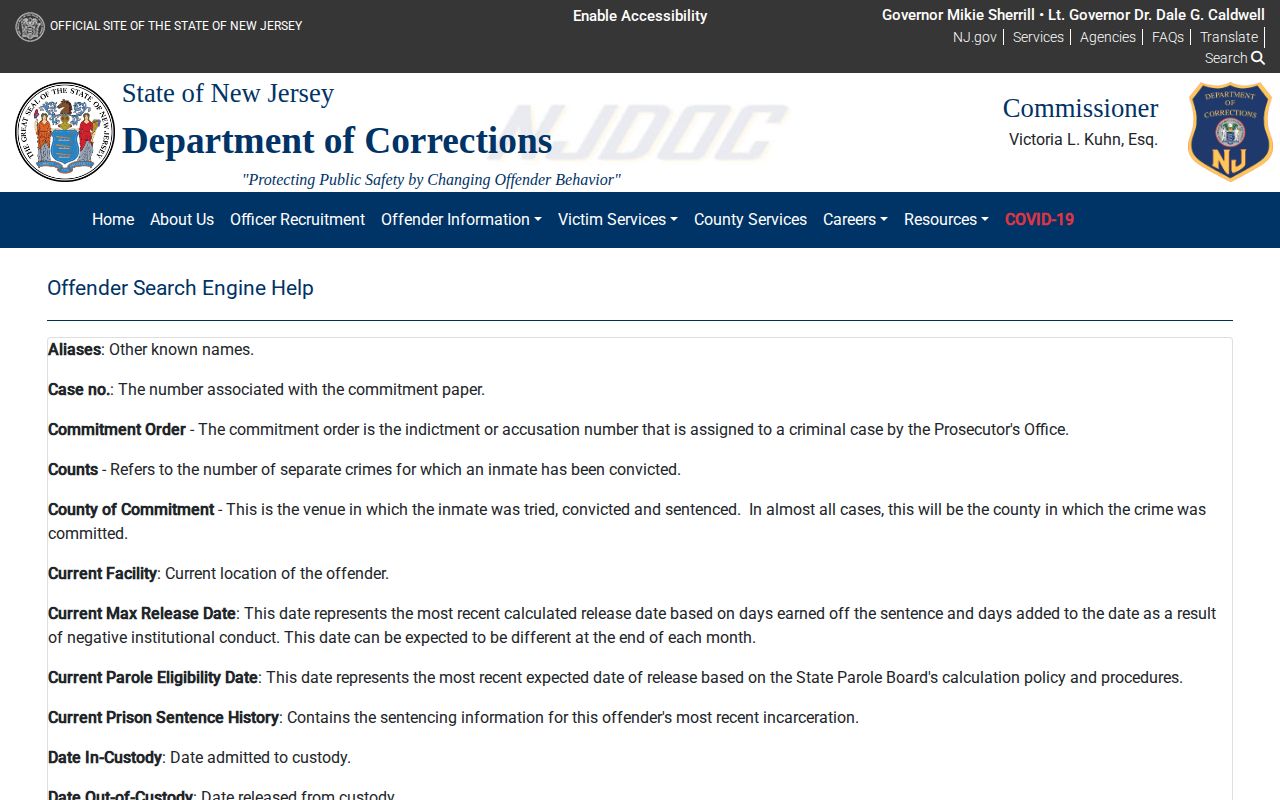
A live result should be matched by SBI, identity details, county, and case before any displayed date is recorded.
Note: NJDOC documentation supports these field meanings, but a live record may require identity checks and acceptance of the search disclaimer.
Find a Cape May Release Date
Choose the path by custody type. NJDOC is correct for a person committed to state prison, not for someone who served only a Cape May County jail sentence. The county's current-list explanation also shows why that roster is not a future-date source. It covers current assignment, updates on weekdays, and removes satisfied charges later. For a county sentence, Jail Records and the court are the practical sources.
- Identify the custodian: Cape May County Correctional Center, NJDOC, federal custody, immigration custody, or another county.
- For NJDOC, open the Offender Search, accept its disclaimer, and search by name with SBI or other identifiers when known.
- Match County of Commitment and case information. Read Current Max Release Date and Current Parole Eligibility Date as separate fields.
- For a Cape May County sentence, obtain the judgment, sentence start, jail credit, and mandatory minimum, then ask Jail Records for the public route to the operative discharge calculation.
- For a person awaiting trial, check bond and court orders. Do not invent a fixed release day where no sentence calculation exists.
- After the date passes, confirm the event through Date Out-of-Custody, a county discharge record, or the actual receiving authority if a transfer occurred.
Federal and immigration dates belong to separate systems. BOP can display a federal release date, while ICE's locator is mainly a current-custody tool. Neither replaces Cape May County or NJDOC records.
Cape May Release Credits Explained
NJDOC's family guide describes commutation, work, and minimum-custody credits. Commutation credit is often called good time and can be forfeited for misconduct. Work credit is generally one day off for each five days spent in an assigned work role or qualifying educational or vocational assignment. Minimum-custody credit is three credits per month for the first twelve months and five per month after that in qualifying minimum or community custody classifications.
New Jersey law supplies the framework. N.J.S.A. 30:4-140 addresses commutation credit. N.J.S.A. 30:4-92 addresses work and minimum-custody credit, while N.J.S.A. 30:4-92a addresses special credits. These provisions explain inputs to a calculation; they do not authorize a reader to compute a binding Cape May County projected release date from a sentence length alone.
Credits cannot erase a judicial or statutory mandatory minimum. NJDOC says commutation, work, and minimum credits cannot reduce that minimum. Court-awarded credits may still matter as applicable. The sentencing record and corrections calculation must be read together.
Cape May Parole Eligibility Dates
Under N.J.S.A. 30:4-123.51, ordinary parole eligibility follows a mandatory minimum when one applies. Without one, the general calculation is one-third of the term less allowed credits. Adult county-jail eligibility has special language tied to sixty days of the aggregate sentence or the subsection calculation, whichever is greater. Eligibility allows consideration; it does not compel release.
The State Parole Board can grant parole, deny it and set a Future Eligibility Term, defer for more information, or impose pre-release conditions. A granted date can still rely on projected work or minimum credits. NJSPB says a new date may be needed if those credits are not earned. Rescission proceedings can also occur before release when new adverse information or misconduct arises.
A Cape May County prospective parole notice is not a decision. Such a notice says consideration will occur not earlier than the listed point. It should not be reported as an appointment, a grant, or a completed discharge.
Note: A Current Parole Eligibility Date marks an eligibility calculation; it does not establish that parole was granted or release took place.
Cape May NERA Release Limits
New Jersey's No Early Release Act, N.J.S.A. 2C:43-7.2, creates an eighty-five-percent parole-ineligibility term for enumerated first- and second-degree offenses. The rule does not apply to every New Jersey inmate. The statute lists covered offenses, including specified homicide, assault, kidnapping, sexual, robbery, carjacking, arson, burglary, and related attempt or conspiracy offenses.
NERA also provides a parole-supervision term after incarceration, generally five years for a first-degree offense and three years for a second-degree offense as the statute directs. Thus, release from prison may begin supervision rather than end the legal sentence. Read the offense, degree, judgment, and mandatory-minimum fields before concluding that an eighty-five-percent rule applies to a Cape May County case.
Broad estimates are risky. A similar offense name may not establish the precise statutory subsection, and sentence amendments or corrected credits can alter the underlying calculation. The entered judgment and corrections record are controlling sources.
Why Cape May Release Dates Change
A projected date is dynamic because its inputs can change. NJDOC specifically says Current Max Release Date may differ at the end of each month. Some changes reflect earned time. Others result from discipline, a corrected judgment, or a new legal restraint. The safest record states the exact field and the access date.
| Factor | Possible effect | Verification source |
|---|---|---|
| Monthly credit accrual | May move the calculation as qualifying credit is earned | NJDOC sentence calculation |
| Forfeited commutation credit | Can add time back after negative institutional conduct | NJDOC disciplinary and calculation record |
| Corrected jail or court credit | Can change the sentence balance | Entered court order and corrections calculation |
| New sentence or amendment | May alter aggregate terms or minimums | Court judgment and sentence history |
| Detainer or transfer | Can prevent community release even when one custody period ends | County discharge or transfer record and receiving agency |
| Parole grant, denial, or rescission | Can set, postpone, or remove an expected parole date | NJSPB action and NJDOC history |
A Cape May County roster disappearance cannot identify which row applies. The current list may also remove one satisfied charge while other charges remain. A dated discharge, transfer, or court record is needed.
Cape May County Sentence Calculations
Do not apply an NJDOC field mechanically to a county-jail sentence. Start with the Cape May County judgment, sentence start, jail credit, and any mandatory minimum. County-verified work may qualify under state rules in some cases, but only the responsible authority can provide the operative calculation. The public current-custody page does not publish a projected date.
Cape May Jail Records maintains information concerning people incarcerated in the correctional center and records court transactions for current inmates. Call 609-465-1233 and follow the prompts. Ask whether the office can identify the proper public record or court source for the discharge calculation. Phone information may be limited, so request a written existing record when the exact date matters.
A transfer must remain distinct from community release. Cape May custody can end because the person enters NJDOC, another county, federal custody, or immigration custody. In that event, the receiving system supplies the next projected or actual date.
Cape May Date Labels Matter
New Jersey's future field is not called simply “projected release.” The exact NJDOC label is Current Max Release Date, and the state warns that earned and lost days can change it monthly. Current Parole Eligibility Date is separate. A generic search result that drops those labels can make an eligibility point look like a firm discharge date.
Date Out-of-Custody is the better field for the completed NJDOC event. Pair it with Date In-Custody, sentence history, and Cape May County of Commitment. For a transfer from the county jail to state prison, the county record proves departure from Cape May custody while NJDOC proves continued state custody. Later Date Out-of-Custody marks the state endpoint.
This label-first method is especially useful after the predicted day has passed. Recheck NJDOC rather than assuming the old date became an actual release. If parole may follow, verify it through the New Jersey State Parole Board.
Confirm Cape May Actual Release
Confirmation comes after the event. For NJDOC, look for Date Out-of-Custody and retain the source and access date. For Cape May County, seek the discharge entry, release authorization, or transfer record through the county government-records route. A court order explains the authority but may precede the actual processing time. When a detainer applies, the receiving agency may show that custody continued.
Prospective New Jersey VINE registration can alert a person to a custody change, but the alert should be read literally and checked against the custodian. The Cape May VINELink inmate-search instructions explain the one-person registration path. For a broader jurisdiction check, the Cape May County released-inmate search separates county, state, federal, and immigration records.
A careful conclusion states no more than the record proves: calculated date, eligibility date, Date Out-of-Custody, county discharge, or transfer. That precision prevents a planned event from being reported as completed release.
Note: Preserve the field name and access date because a calculated Cape May County release date may change before the event.