
Cape May 72-Hour Release Status
No official Cape May County 72-hour release list, recent-release archive, or three-day filter was found in the official pages reviewed as of July 29, 2026. The county instead directs the public to a list of people assigned to current custody. It removes a satisfied charge at the next update and says that incarceration history is not included. The page therefore cannot recreate who left during any rolling period.
The three-day question still has an official answer path. Cape May Jail Records can direct a caller to the available custody endpoint information. A bounded records request can seek the existing discharge report and release or transfer authority. Court records can explain the order or sentence behind the change. Each source has a separate role, and together they are more reliable than three saved roster views.
Check Cape May Three-Day Releases
Define the time window first. Write down the start and end date and time, then identify whether the person was in the Cape May County Correctional Center, an NJDOC institution, federal custody, ICE custody, or only a municipal holding cell. Cape May Jail Records cannot confirm an episode that never reached the county center, and a county exit cannot prove that all custody ended.
- Review the county’s current-list rules, then check the live list and save the access time, inmate ID, committed date, and each matching charge row.
- Call Jail Records at 609-465-1233. Ask whether the person remains assigned to Cape May custody and how to obtain the public record of the recorded outcome.
- Check the related New Jersey court case. Look for bail action, dismissal, sentence completion, a new commitment, or an order tied to the relevant dates.
- Request records sufficient to show the custody disposition and effective date for the defined episode. Include the discharge report and release or transportation authority.
- If VINE registration was active, preserve the exact alert and its time. Confirm that literal event with Jail Records, NJDOC, or the court.
This method focuses on a named person and a fixed episode. A broad request asking an office to create a new list may fail because OPRA provides existing records, not new compilations. If an existing daily discharge report is needed, name that record series and the exact dates.
For only the most recent day, the Cape May 24-hour jail release check keeps the inquiry focused on same-day verification.
Cape May 72-Hour Release Fields
The published roster fields are not release fields. They can help identify a custody episode before the row disappears, but none supplies a discharge time or a receiving agency. The distinction matters most across three days because several unrelated changes can occur between the first and last view.
| Available current-list field | Use in a three-day inquiry |
|---|---|
| Name, age, inmate ID | Match the person and carry a stable county ID into a records call or request. |
| Committed date | Defines the start of the listed episode, not its end. |
| Committing authority | Helps locate the court or agency that placed the person in county custody. |
| Charge rows | Show active charges at the update; one person can appear more than once. |
| Detainer and bail status | Supply leads about holds and current bail, but not proof of the eventual outcome. |
| Release date, time, reason, destination | Not documented on Cape May’s public current-list page; seek the discharge and authority records. |
A well-framed request asks for identity and inmate or booking number, admission date, discharge date and time, releasing authority, release type, related court or case number, and destination or receiving agency when recorded and releasable. Not all fields must be open, so request the nonexempt parts and the legal basis for any redaction.
Cape May Weekend Release Gaps
Cape May says the current list updates once per day from Monday through Friday, except holidays. A three-day span from Friday evening through Monday morning therefore cannot be read like a live transaction log. The Friday view may remain online while release, transfer, or court events take place. Monday’s update can remove those rows without assigning a Saturday, Sunday, or Monday exit time.
A court order also has its own time. The order may be entered before the jail finishes release processing. A VINE notice may arrive near a custody change, but its time should not be substituted for the discharge record’s effective time. When exact timing matters, compare the entered order, the jail discharge entry, and any transfer receipt.
Note: A holiday can extend the public-list gap beyond three calendar days, so record the county’s update schedule with each check.
Cape May Release Data Quirks
Cape May’s public data has two local rules that defeat simple before-and-after counts. First, each active charge receives its own row. A single person may therefore look like several inmates in a copied list. Second, a satisfied charge leaves on the next update after bail, an associated court order, or sentence completion. One row can disappear while another remains, so the change may concern a charge rather than the person’s physical custody.
Even the disappearance of every row does not identify the destination. A person can bond out, finish a county term, enter EMP or SLAP, transfer on an outside detainer, enter NJDOC after a state sentence, or move to another sovereign’s custody. Electronic Monitoring Program participants live outside the jail but remain under Sheriff and court restrictions. A transportation receipt or program record may therefore be more probative than a release label.
The official county current-list explanation is shown below.
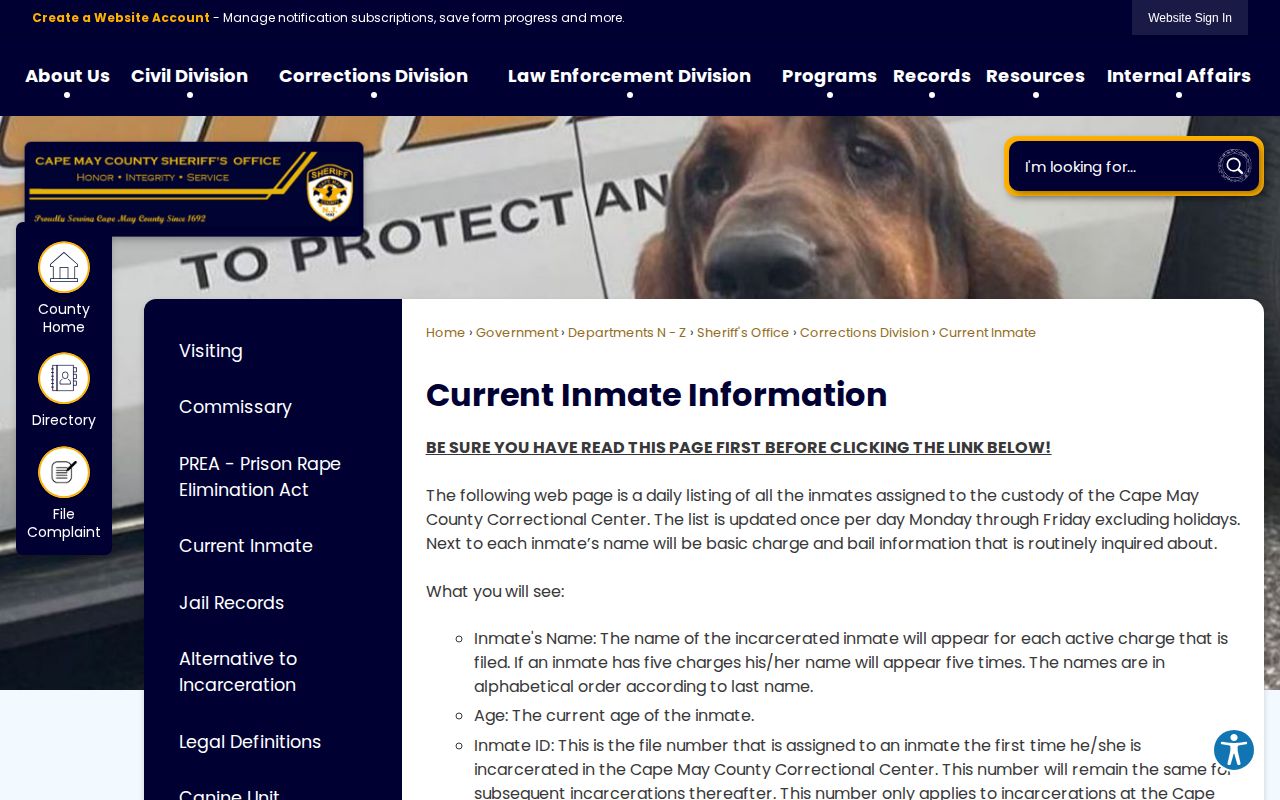
The screenshot documents why a Cape May County three-day release inquiry must move beyond current-list subtraction.
Cape May Three-Day Release Records
New Jersey’s county jail retention schedule gives useful record names. Population, commitment, and discharge reports have a three-year minimum retention period. A commitment register is permanent at the agency. The inmate history daily working file, also retained three years after release, can include court slips, custody receipts, bail orders, recognizance records, transportation receipts, property receipts, and Parole Board correspondence. These time frames concern retention, not automatic public access.
For one person, ask for the existing booking or admission record, discharge report, and release or transfer authorization for a narrow incarceration range. State that electronic copies are preferred. Include the full name, date of birth if known, and inmate ID if available. Avoid unnecessary personal identifiers. If only the endpoint is needed, ask for records sufficient to show the recorded custody disposition and effective date rather than the whole inmate file.
For a group inquiry tied to one date, ask whether an existing daily discharge report covers that period. Define the exact date rather than asking the custodian to research a newly composed “72-hour list.” The response may contain lawful redactions, and the three-year schedule is a minimum retention rule rather than a promise of full disclosure.
Cape May’s Jail Records office is the immediate local channel. The county Government Records route handles a durable OPRA request, while the Judiciary’s own access process applies to court files. Sending a court-record request to the county can delay the answer because these are separate custodians.
The official Cape May Jail Records source appears in the image below.
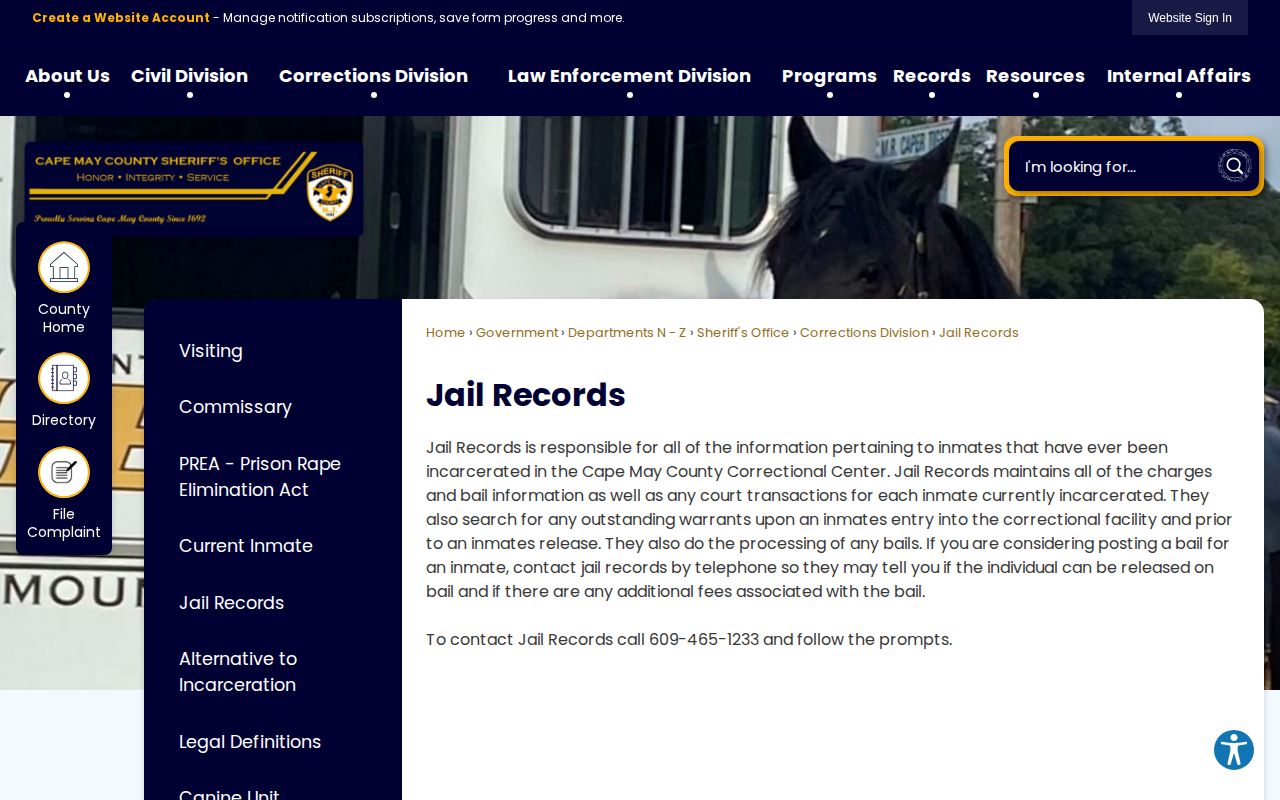
Its role is durable episode verification, not publication of a rolling three-day list.
Cape May Release or Transfer
The county endpoint is only one part of the custody chain. If the court imposed a state-prison sentence, search NJDOC and match the county of commitment and case information. Date Out-of-Custody can confirm the end of a documented NJDOC period, while Current Max Release Date is only a changing calculation. If an outside detainer controlled the move, ask Cape May for the transportation record and receiving agency before searching another system.
Federal and immigration changes follow different routes. The BOP Locator can retain records for many people released from federal custody, sometimes with a release date. ICE’s locator is mainly for present detention and recent ICE releases, so no result cannot explain a county disappearance. A municipal police release that never became a Cape May jail booking belongs with the arresting agency and the correct municipal or Superior Court case.
Released and still in custody must remain distinct. Presence on Cape May’s current list supports current county assignment as of its update. Absence does not establish community release. A signed or entered release or transfer authority, discharge entry, related court order, or receiving-custodian record supplies the defensible conclusion. The Cape May County released inmate search sets out the full named-person path when the proper custodian is not yet clear.