
Cape May Parole and Probation
Parole follows a prison release and is administered by the New Jersey State Parole Board, or NJSPB. It permits a person to serve part of a sentence outside prison under written conditions. Probation comes from a court order and is administered through the New Jersey Judiciary. It may be part of a sentence that does not include state prison. Cape May County records should therefore be read from the sentence outward, not from the simple fact that someone is no longer in the county correctional center.
The legal source also differs. NJDOC custody history can show Date Out-of-Custody for a state-prison term, but that field does not state that parole has ended. A court judgment may impose probation and identify its term, but the public docket may not show day-to-day status. The Atlantic/Cape May Vicinage handles local probation. Neither system should be treated as a public list of all people who have left Cape May County custody.
| Point | Parole | Probation |
|---|---|---|
| Authority | New Jersey State Parole Board | New Jersey Judiciary |
| Typical source | Release from a state-prison sentence | A sentence or condition entered by a court |
| Cape May route | NJDOC history, NJSPB Public Information, District Office 8 | Court disposition and Atlantic/Cape May Vicinage Probation |
| Public name lookup | No standalone NJSPB parolee-name database was found | No public person-level probation lookup was found |
| End point | Discharge from parole or other documented termination | Completion, discharge, modification, or termination under court authority |
Cape May Supervision Terms
A precise term helps prevent a false conclusion. Leaving the Cape May County Correctional Center can mean community release, transfer, electronic monitoring, state-prison commitment, or another legal outcome. Supervision begins and ends only as the governing record provides. It cannot be inferred from a roster search or from a failure to reach the person.
- Parole
- Release from incarceration while legal custody and supervision continue under NJSPB conditions.
- Probation
- A court-ordered sentence or condition supervised through the Judiciary rather than the Parole Board.
- Discharge
- The documented end of a custody or supervision period, depending on the record being read.
- Absconder
- A formal supervision status, not a label that can be inferred from a missed call or an online no-result.
- Detainer
- A request or hold from another authority that can lead to transfer instead of community release.
These distinctions also apply to Cape May County's alternative programs. A participant may live outside the jail while remaining under a court order and Sheriff's control. That is not the same as discharge from the sentence.
Note: A Cape May County roster absence proves neither community release nor the type or current status of any supervision.
Verify Cape May Post-Release Supervision
Verification starts with the system that imposed the term. For a person transferred from Cape May County to state prison, use the NJDOC Offender Search and match more than the name. County of Commitment, SBI number, sentence history, and case details help distinguish similar identities. For a county-only stay, the Cape May Jail Records office is the local custody endpoint. Date Out-of-Custody confirms the recorded state-custody endpoint. It does not by itself tell whether parole remains active.
For probation, review the New Jersey court case and identify the judgment or later order. For parole, use NJSPB Public Information after matching the NJDOC record. Confidentiality and record limits may prevent the agency from giving every detail, but the office can direct a focused public inquiry to the proper channel.
- Identify whether the person served only a Cape May County jail term, entered NJDOC, or received a court probation sentence.
- Match the person with at least two identifiers, such as full name, birth information, SBI number, inmate ID, or case number.
- For state prison, read NJDOC Date Out-of-Custody and the sentence history. Do not treat a future calculated date as an event.
- For parole, contact NJSPB Public Information and ask whether any publicly confirmable supervision information exists and which district is responsible.
- For probation, check the court disposition, then contact Atlantic/Cape May Vicinage Probation for procedural guidance.
- Record the source and access date. Use the agency's exact wording rather than broadening a limited response.
Cape May Supervision Office Contacts
Cape May County parole is served by an office outside the county. The official NJSPB annual report places District Office 8 in Pleasantville and says it serves Atlantic, Cape May, and southern Ocean counties. Probation remains a Judiciary function within the shared Atlantic/Cape May Vicinage. Call before travel because no universal public reporting schedule applies.
New Jersey State Parole Board Public Information
Phone: 609-292-4257
Email: SPB-Public-Info-Office@spb.nj.gov
District Parole Office 8
700 Black Horse Pike, Suite E-1
Pleasantville, NJ 08232
Phone: 609-415-6630
Cape May Probation
Atlantic/Cape May Vicinage
Phone: 609-402-0100 ext. 47190
The NJSPB contact page is the best source to recheck a state contact before making an inquiry. A district office is not a walk-in name-search service, and the probation line may only give procedural help when person-level information is restricted.
The official parole contact view shows the state route used for Cape May County questions. It helps separate the public-information function from a person's assigned field office.
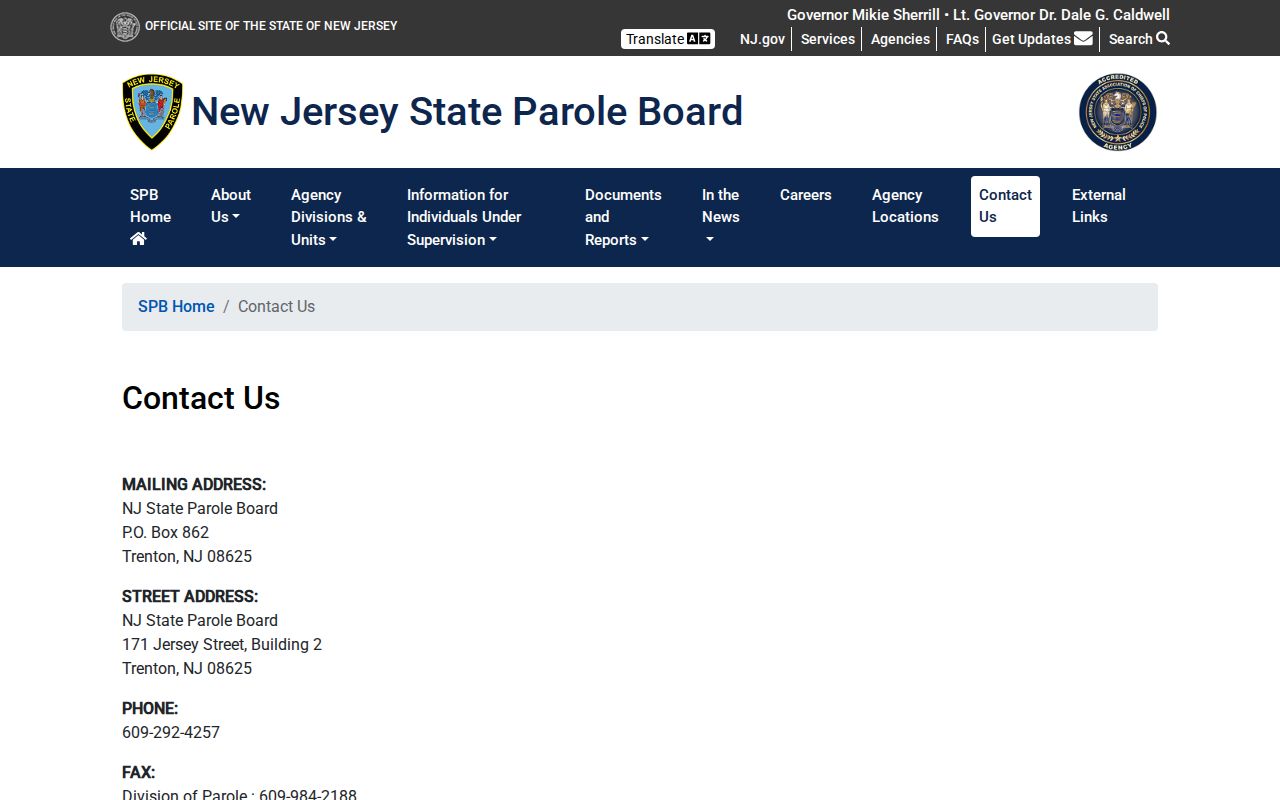
Use the current state page to confirm contact details because office assignments and directories can change.
Cape May Parole Reporting in Pleasantville
A Cape May County releasee assigned to state parole receives written reporting instructions. The Adult Parole Handbook says the person reports to the office named in those instructions, reviews conditions with an officer, and receives an assigned officer and next reporting date. Reporting may be weekly, biweekly, or monthly. The frequency is individual, so publishing a single Cape May County check-in schedule would be inaccurate.
District Office 8 matters because it serves Cape May County despite its Pleasantville address. Yet a directory listing does not prove that a named person reports there now. Transfers between districts, individualized instructions, and the kind of supervision can affect the responsible office. NJSPB Public Information is the proper first contact when the district is uncertain.
The NJSPB locations directory displays the district-office structure used for local reporting, as shown in the official view below.
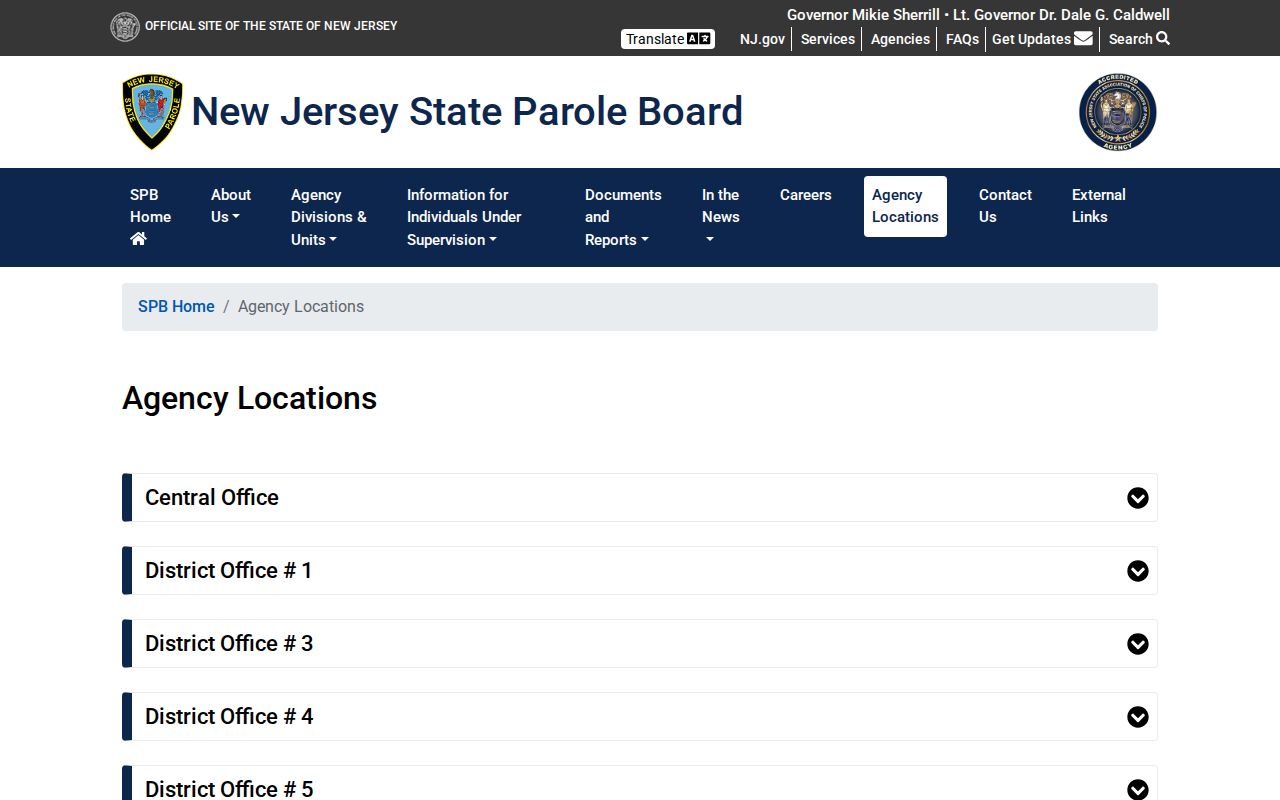
Always follow the releasee's written instructions over a general directory entry.
Note: District Office 8 serves Cape May County, but only NJSPB can confirm the office responsible for a particular supervision record.
Cape May Alternatives Are Not Discharge
Cape May County operates two named alternatives to incarceration: the Electronic Monitoring Program, or EMP, and the Sheriff's Labor Assistance Program, or SLAP. The county describes participants as being out of jail, but each program remains tied to court authority and Sheriff's rules. EMP is for Cape May residents. SLAP is for people sentenced in Cape May County and usually involves reporting to a community-service site.
This middle status is easy to misread. A person at home on electronic monitoring has physically left the correctional center, yet the sentence may still be active. Likewise, participation in SLAP is not proof that probation, parole, or the full sentence has ended. Confirm the alternative-program order in the sentencing case and obtain the appropriate county record for completion or termination.
The county's Alternative to Incarceration page is the official source for these local programs. It should be read alongside the court disposition, not used as a person-level lookup.
Cape May Parole Conditions and Changes
Parole conditions are provided in writing and reviewed with the assigned officer. Reporting frequency, residence directions, treatment or program terms, movement limits, and other conditions depend on the case. Probation conditions come from the court and may be changed only through the proper Judiciary process. Cape May County has no single public page that lists a named person's complete active conditions.
A claimed violation is not the same as a final revocation. NJSPB describes a hearing process that can continue parole or revoke it and establish a new future eligibility term. New information before release can also cause a rescission hearing. Court action controls probation violations. For either system, use the agency or court's literal status and do not infer the result from an arrest, a missed report, or a prospective notice.
New Jersey VINE can provide custody-change alerts, but it is not a durable supervision archive. A VINE event should be saved and checked against NJDOC, NJSPB, Jail Records, or the court record that created the legal change.
Cape May Parole Absconder Checks
NJSPB's Fugitive Unit investigates parole absconders. The state publishes a tip line at 1-800-668-7025 and an email address, SPB-Fugitive-Tip-Submit@spb.nj.gov. No official statewide, name-browsable absconder list was found in the official review completed for Cape May County. The tip channel is meant to receive useful information, not to check whether a person has a formal status.
Failure to find a name online proves nothing. A person may have completed supervision, moved to another district, have restricted information, or simply not appear in a public tool. Begin with NJDOC identity and custody history, then ask NJSPB Public Information about the proper public verification route. Use “absconder” only when a reliable agency record uses that term.
Note: The NJSPB Fugitive Unit tip line accepts information; it is not a public Cape May County parole lookup.
Cape May Supervision Discharge Records
Supervision ends through a documented agency or court action. For parole, seek a discharge or other NJSPB record that states the supervision endpoint. For probation, read the court docket and obtain the order when a public summary is unclear. A state-prison Date Out-of-Custody is evidence of the NJDOC custody endpoint, not automatic proof that all parole or statutory supervision has ended.
A Cape May County discharge inquiry should identify the person, sentence or case, and type of supervision. Ask only for an existing public record. Parole hearing records and transcripts can be confidential under state regulation, so a requester should not assume that a full file will be produced. If only the county custody event is at issue, the site's Cape May County released-inmate search and record path explains why Jail Records and the court case are the durable sources.
Keep a narrow conclusion. “NJDOC records a Date Out-of-Custody” is different from “NJSPB confirms discharge,” and both differ from “the court records completion of probation.” That wording preserves the legal boundary between custody, parole, and probation.